
How EPR Reconciliation Actually Works: A Practical Guide for Businesses
By Cirqulus Solutions
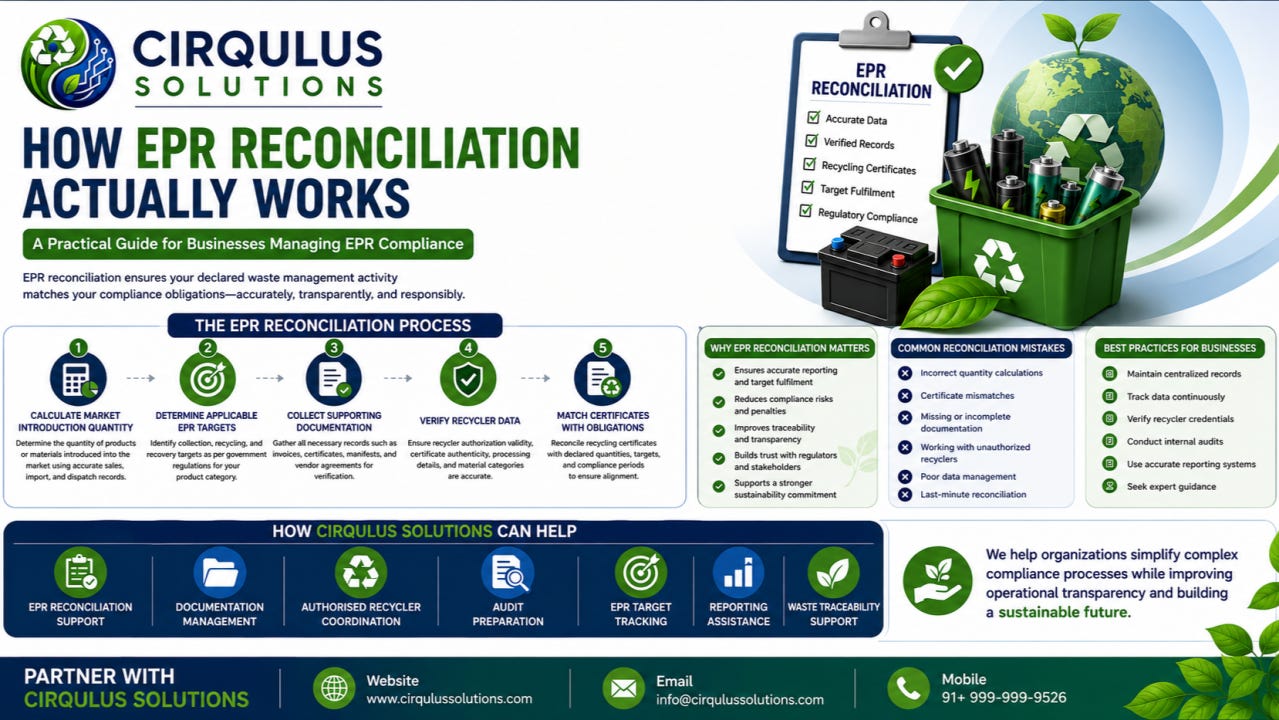
♻️ EPR Reconciliation: Turning Compliance Data into Verified Accountability
EPR compliance is not simply about submitting numbers or obtaining recycling certificates. The real challenge is ensuring that every piece of compliance data tells the same story.
From the quantities of products introduced into the market to applicable EPR targets, supporting documentation, recycler records, and certificates, each element needs to be accurately tracked, verified, and reconciled.
But how does EPR reconciliation actually work?
The process begins with calculating the relevant market introduction quantities and determining the applicable EPR obligations. Businesses then need to collect and organize supporting documents, verify recycler credentials and records, and ensure that recycling certificates correspond with the declared quantities and compliance targets.
A well-managed reconciliation process can help businesses identify gaps before they become larger compliance issues.
Common challenges include:
🔹 Incorrect quantity calculations
🔹 Certificate and obligation mismatches
🔹 Missing or incomplete documentation
🔹 Poor data management
🔹 Working with unauthorized recyclers
🔹 Last-minute reconciliation
🔹 Inconsistent or unverifiable records
These issues can make regulatory reporting more difficult and increase compliance and audit risks.
That is why businesses need a structured approach to data management, documentation, recycler verification, certificate tracking, and target reconciliation.
At CIRQULUS SOLUTIONS, we support organizations in simplifying complex EPR processes through:
✅ EPR reconciliation support
✅ Documentation management
✅ Authorized recycler coordination
✅ EPR target tracking
✅ Reporting assistance
✅ Audit preparation
✅ Waste traceability support
Our approach focuses on helping businesses create compliance systems that are accurate, transparent, traceable, and audit-ready.
Because effective EPR compliance is not just about having the right documents.
It’s about making sure the data behind those documents is accurate, consistent, and verifiable.
As EPR regulations continue to evolve, businesses that invest in strong data and reconciliation processes will be better positioned to manage compliance efficiently and demonstrate genuine environmental responsibility.
📩 Looking to strengthen your EPR reconciliation and compliance process? Connect with CIRQULUS SOLUTIONS.
#EnvironmentalAwareness #CircularEconomy #WasteManagement #Ewaste #Recycled #EcoFriendly #Sustainability #ZeroWaste #GreenPlanet #Business #WasteReduction #IndustrialRecycling #GoGreen #RecycleMetal #WasteReduction #SavePlanet #SaveThePlanet #ESGGoals #ResponsibleRecycling #EPR #extendedproducerresponsibility #cpcb #sustainability #esg #cirqulussolutions